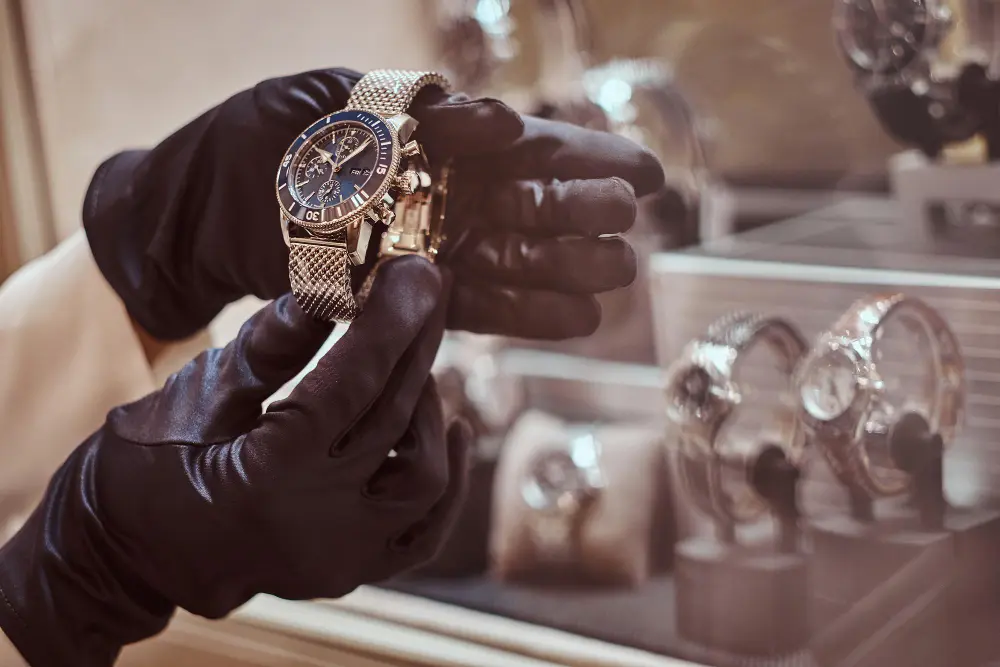
I have spent over a decade in the luxury watch market, and I check every watch in the same order: papers first, then the serial number, then the watch itself. Fakes, missing paperwork and a watch in worse shape than it looks are the things that catch people out. If you are browsing pre-owned watches in Dubai, whether with us or anyone else, run the checks below on any watch you like the look of before you hand over any money, and you cut that risk a good deal. Here is what each step involves, in the order I do them.
Do you need the box and papers for a pre-owned watch?
Yes, and it is the first thing I ask for. Box and papers confirm a watch is what it claims to be faster than anything else can. It makes no difference whether it is a Rolex, an Omega, a Patek Philippe, a TAG Heuer, a Breitling or a Cartier: the routine is the same.
I would suggest asking the seller for photos of the papers first. Photos are a good start, but I match the papers against the watch when it is in front of me, and if they do not agree, I go no further.
Cartier changed its paperwork around 2016. Newer watches come with an international warranty card, older ones with a warranty certificate. Both count as papers, and either one is worth keeping.
Please don’t be put off by a watch that has no papers, because that does not automatically make it a fake. With no papers, it comes down to experience: I have to work out for myself whether the watch is genuine. In that case the serial number check and the hands-on inspection below carry more weight. If you are buying a watch without papers, it is also worth asking who is examining it and how much experience they have with that brand, because the decision rests on them.
Can a serial number prove a watch is real?
Not on its own. A serial number check is a strong test, but never a flawless one. I put it at about 99% reliable, never 100%, because some very good fakes copy a genuine serial number, so the number can match the model perfectly.
Several brands, including Breitling, Omega, Cartier, IWC and Panerai, can confirm a serial number, either directly or through their website or registration portal. What differs between brands is how each one confirms it. The check itself hardly changes.
With no box or papers, the serial number counts for more. That said, a matching serial is never a good enough reason to trust a watch. A fake copied from a real watch can get past it, which is why hands-on experience with the real thing matters. It is what I rely on to be sure, and it is the last step in my order.
Which condition problems matter on a pre-owned watch?
In practice, it is the ones that make a watch unsellable as it is. A polish or a worn strap is not one of them.
I start with the case and the bracelet or strap, and I ask one question: could I sell this watch exactly as it is? A watch that needs a polish does not worry me. A worn strap or bracelet is a minor point and does not make a watch a bad buy.
After that I move to the bezel and the glass. Then comes the movement, which has to work. On a quartz watch I want to see a battery in it and the watch ticking. On an automatic, I want a second hand that sweeps smoothly.
In fact, every pre-owned luxury watch I look at goes through that same list: case, bracelet or strap, bezel, glass, movement.
Six checks before you pay
Here are the six checks I would run, in this order, before any money changes hands:
- Papers. If there are papers, they match the watch in front of you. If there are none, you lean on the serial check and an experienced eye.
- Serial number. It matches the watch, and the brand can confirm it where it offers that service.
- Case and bracelet or strap. You could sell the watch as it is.
- Bezel. It is in good condition.
- Glass. It is in good condition.
- Movement. A quartz is ticking, an automatic has a sweeping second hand.
That is the same order every time: papers, serial number, then the condition checks on the watch itself. The checks hardly change from one brand to the next, so you can use them on a Rolex, an Omega, a Cartier or a Patek Philippe. That said, if the papers and the watch do not agree, it is best to stop there.
How do you judge a seller in the UAE?
A few questions tell you a lot about a seller, and buying a used Rolex or any other luxury watch in Dubai is safer when the answers are good.
It helps to ask four simple things. Do they show you the papers? Will they let you inspect the watch in person? Do they answer your questions about the serial number plainly? And is there a shop you can visit and reviews from other customers you can read? A seller who is happy with all four has nothing to hide.
At Bramleys I start with papers, then the serial number, then the watch itself, and you are welcome to hold me to it. And if you would like to see a watch in person, Bramleys welcomes walk-ins.
Dean Bramley has worked in the luxury watch market for over a decade. He co-founded Bramleys Luxury, a boutique in the InterContinental Hotel, Dubai Marina.