Payroll does not look complicated from the outside. A company hires people, tracks their working days, calculates salaries, deducts what needs to be deducted, pays everyone, and keeps records.
But it is not that clean. For example, people forgot to regularize attendance. At the same time, someone worked overtime, but the manager approved it late. Maybe one employee went on unpaid leave for two days, but the payroll sheet still shows full salary for that person. A new joiner’s bank details are missing. Another person resigned mid-month, and now the final settlement has to be checked manually. Then there are deductions, allowances, leave balances, reimbursements, holiday work, late marks, salary advances, and compliance deadlines sitting quietly in the background.
This is where payroll errors begin. Not because HR teams are careless. Most of the time, they are overworked, depending on too many spreadsheets, too many WhatsApp confirmations, and too much memory.
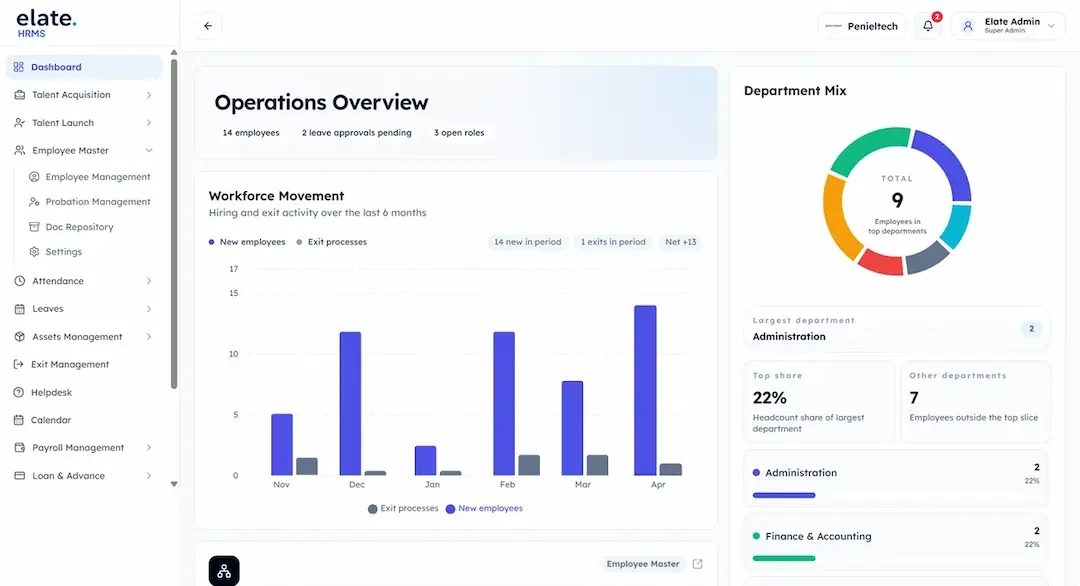
HRMS software reduces payroll errors by bringing employee data, attendance, leave, salary structure, approvals, deductions, and compliance records into one connected system.
Payroll errors usually come from scattered information
Most payroll problems happen because payroll depends on too many moving parts.
Attendance stays in one place, and leave approvals are in another. Similarly, overtime requests are sitting in the email. People manage salary revisions in Excel and discuss deductions on WhatsApp. Final settlement details are checked from old files. By the time payroll is prepared, HR is hunting for the truth.
An HRMS brings these details into one system. Employee master data, salary structure, attendance, leave, overtime, deductions, loans, benefits, approvals, and payroll history sit together. So when payroll is processed, the system doesn’t depend on someone’s memory. That alone reduces a lot of damage.
Correct salary calculation starts with clean employee data
Every payroll run begins with employee data. If that data is wrong, everything after it becomes wrong too.
An HRMS stores details such as:
- Basic salary
- Allowances
- Employment type
- Joining date
- Work location
- Department
- Grade or designation
- Leave policy
- Overtime eligibility
- Deductions
- Bank details
- Applicable statutory rules
This matters because payroll is not just “monthly salary divided by days.” Real payroll has exceptions like someone joining in the middle of the month or someone resigning before salary day. Someone worked on a rest day. Someone took unpaid leave. Someone received a salary increment effective from the 10th, not the 1st.
HRMS software applies the configured rules consistently. Once the data is correct, the system calculates salary based on actual attendance, leave, working days, overtime, and deductions.
On-time payment becomes easier because payroll has a workflow
Delayed payroll is not always a cash problem. Many times, it is a process problem like unapproved attendance, pending leave, and unconfirmed overtime. Simultaneously, the finance team wants the final salary sheet, HR is still checking corrections, and everyone knows salary has to go out, but the inputs are late.
A proper HRMS gives payroll a timeline. It fixes attendance cut-off dates. Managers can receive approval reminders, and pending leave requests can be visible before payroll processing. Overtime claims can be approved or rejected before salary calculation starts. Overall, payroll can move through maker-checker approval, where one person prepares it and another reviews it before final processing.
Overtime mistakes reduce when attendance and policy connect to each other
Wrong overtime payments are one of the most common payroll issues. Sometimes employees are underpaid. Sometimes the company overpays. Both create problems.
HRMS software helps by linking attendance data with overtime rules. The system can calculate extra hours, apply the right multiplier, exclude non-eligible employees, and send unusual cases for approval.
This is especially useful in companies with shift workers, retail staff, warehouse teams, construction teams, drivers, security staff, or service technicians. These are the teams where overtime is not occasional. It is part of daily operations. And when overtime is frequent, manual calculation eventually breaks down.
Leave balances become more factual
Elate HRMS software reduces arguments regarding leave balance because leave accrual, usage, carry-forward, encashment, and unpaid leave can be tracked inside the system.
Employees can see their own balances. Managers can approve leave through the system. HR can check the history. Most importantly, payroll can automatically treat unpaid leave correctly when the salary is processed.
This does not remove every disagreement. People will still ask questions. But the conversation becomes easier because there is a record.
For UAE companies, this is especially important because annual leave, leave pay, and end-of-service calculations can affect payroll and final settlements. If leave balances are poorly maintained throughout employment, the problem becomes bigger when the employee resigns.
Final settlement is not the right time to discover that leave records are messy.
Deductions need control
Deductions are another place where payroll goes wrong quietly. Salary advances, loan repayments, unpaid leave, late penalties where legally allowed, insurance deductions, pension contributions for eligible employees, or other approved recoveries must be handled carefully. One missed deduction affects company records, and one extra deduction affects employee trust.
An HRMS can manage deductions with clear rules. It can record the deduction type, amount, start date, end date, approval status, and remaining balance. If an employee took a salary advance to be recovered over six months, the system can deduct the agreed amount every month and stop when the balance is cleared.
Compliance risk comes down when rules are built into the process
Payroll compliance is not only about paying people. It is about paying them correctly under the law.
That includes wage payment rules, working hours, overtime, leave, deductions, pension or social security contributions where applicable, tax withholding in countries that require it, payslip records, audit trails, and reporting obligations.
In the UAE, companies do not deal with personal income tax for employees, because the UAE does not levy income tax on individuals. But that does not mean payroll compliance is light. Employers still need to manage WPS salary payments, labour law requirements, leave, overtime, end-of-service benefits, and pension/social security obligations for eligible UAE and GCC nationals.
A strong HRMS can help by updating statutory tables and applying configured compliance rules. It must also generate reports and alert HR when something is missing.
The uncomfortable truth is, software does not remove responsibility from the employer. If the company configures the wrong rule, ignores system alerts, or fails to update employee data, compliance risk remains.
But HRMS does reduce the chance that compliance depends on one person remembering everything. That is a big improvement.
Non-technical HR teams do not need complicated tools
A payroll system should not make HR feel like they need to become programmers. Good HRMS software gives HR staff easy-to-understand screens, guided steps, approval buttons, payroll previews, exception reports, and simple correction options.
For example, HR should be able to:
- Add a new employee without building a salary formula manually
- Update an allowance with an approval trail
- See unpaid leave before payroll is finalized
- Check overtime exceptions
- Generate payslips
- Export bank or WPS files where required
- Review payroll variance from last month
- Lock payroll after approval
That last point is important. Once payroll is finalized, it should not be casually changed. Any correction should have a reason and an approval.
This protects HR as much as it protects the company. Because when payroll goes wrong, people often blame the HR person sitting closest to the problem. A proper system shows the process.
Employees trust payroll when they can see their own information
Payroll accuracy is not only a back-office issue. It affects how employees feel about the company. When employees cannot see payslips, leave balances, overtime status, or deduction details, they start asking HR for everything. HR becomes a helpdesk, and employees become suspicious. Even the correct payroll feels unclear.
HRMS self-service helps reduce that tension. Employees can view payslips, apply for leave, check balances, update certain personal details, download documents, and raise payroll queries.
Managers can approve requests without waiting for email chains. HR can answer questions with records instead of explanations that sound like excuses.
Transparency does not mean every employee will be happy with every payroll result. But it reduces confusion. And confusion is where many payroll disputes begin.
The real value is fewer last-minute surprises
The biggest benefit of HRMS is not that it makes payroll “fast.” Speed is useful, yes. But speed without accuracy is dangerous. The real value is that HRMS reduces surprises.
Before payroll is processed, HR can see missing attendance, pending approvals, unusual overtime, salary changes, unpaid leave, new joiners, resignations, and deduction changes. Instead of discovering problems after salaries are paid, the team can catch them before payroll is closed.
That is the difference between controlled payroll and panic payroll. Every company has exceptions. People join late. Managers forget approvals. Employees miss punches. Policies change. Laws change. No system removes real life from payroll. But a good HRMS keeps real life from turning into a spreadsheet disaster.
HRMS does not replace payroll responsibility
Buying HRMS software does not automatically make payroll compliant. The company still needs proper setup, correct employee data, updated policies, trained HR users, regular reviews, and management discipline.
If overtime rules are configured incorrectly, the system will calculate incorrect overtime very efficiently. If leave policies are unclear, the system will only expose that confusion faster. If managers do not approve attendance on time, payroll will still suffer.
So HRMS is not a shortcut around good HR practice. It is the structure that helps good HR practice survive daily pressure.
A practical way to use HRMS well
Companies get better results when they treat HRMS implementation as a payroll-control project, not just a software installation.
A sensible approach looks like this:
- Clean employee master data before going live
- Confirm salary components and allowance rules
- Map attendance, shifts, overtime, and leave policies properly
- Configure deductions with start and stop dates
- Set approval workflows for managers and HR
- Test payroll with old months before using it live
- Review statutory and local compliance settings
- Train HR users on exceptions, not just basic screens
- Keep payroll reports locked after approval
- Review payroll variance every month
It is an admin discipline. And payroll accuracy mostly comes from admin discipline.
Final thoughts
Overall, payroll errors are expensive, but not only because of fines. They damage trust and waste HR time. They sometimes make employees feel the company is careless with their livelihood. A business can apologize for a mistake, but employees remember repeated salary problems.
HRMS software reduces payroll errors by connecting the details that manual payroll keeps separating: attendance, leave, overtime, deductions, salary structures, approvals, compliance rules, and payment records.
It also reduces compliance risk by making payroll more traceable, more consistent, and less dependent on one person’s memory. That is the quiet value of Elate HRMS. It does not make payroll exciting. It makes payroll less fragile. And for any company that has lived through salary-day chaos, that is more than enough reason to take it seriously.