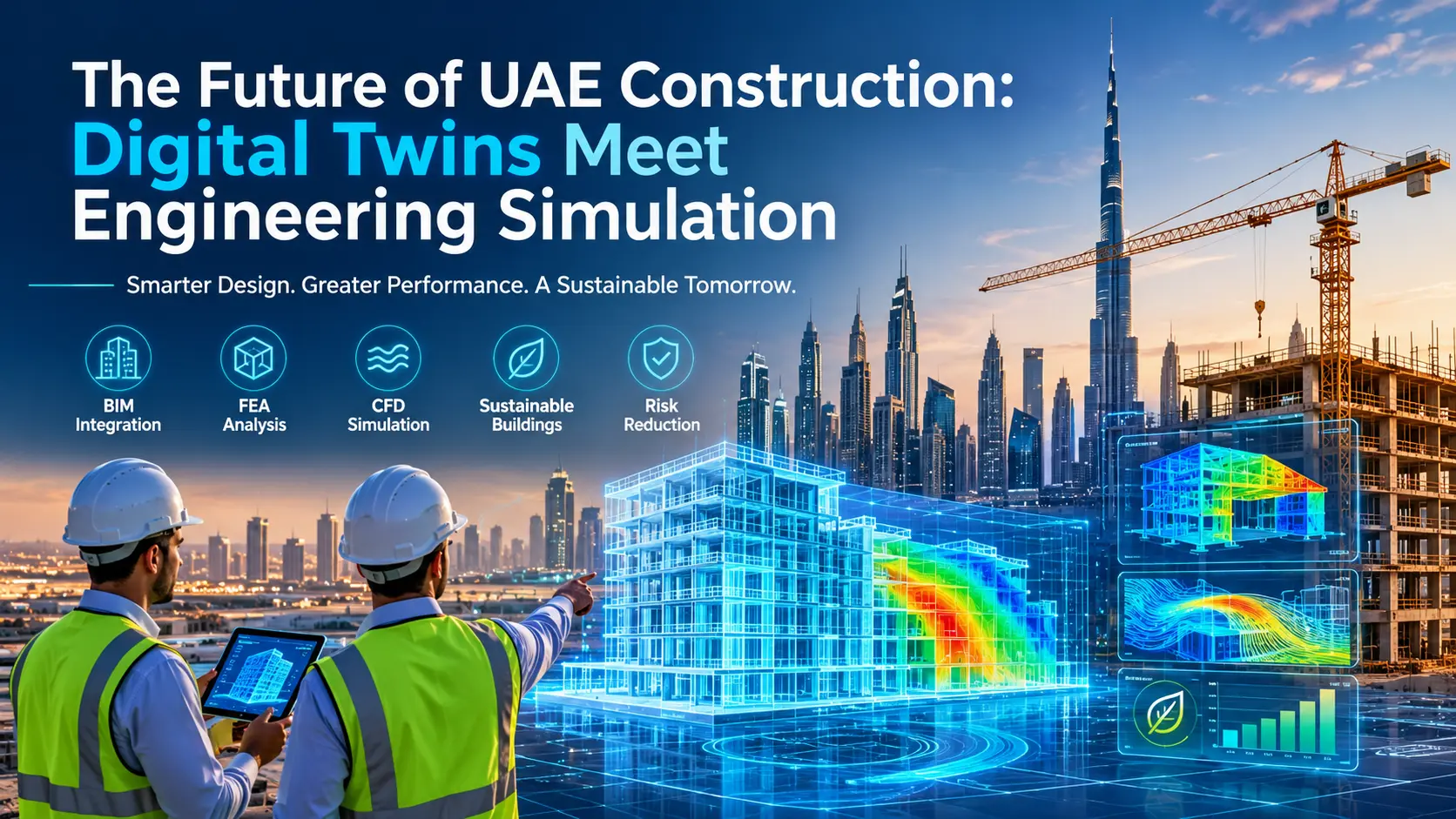
The future of construction is no longer defined solely by what can be designed on a computer screen. Increasingly, it is about understanding how a building, infrastructure system or industrial facility will actually perform before it is constructed.
Across the UAE, this shift is becoming particularly important. Ambitious urban developments, high-rise buildings, smart infrastructure and sustainability initiatives are creating new expectations for construction quality, operational efficiency and long-term resilience.
Technologies such as Building Information Modelling (BIM), digital twins, artificial intelligence (AI) and engineering simulation are changing how projects are planned, assessed and delivered.
However, one important distinction is often overlooked: a detailed digital model does not automatically mean that a building will perform as intended. To make digital engineering genuinely predictive, visual models must be supported by physics-based analysis.
Why Is the UAE Construction Industry Moving Towards Digital Engineering?
The UAE’s built environment is becoming increasingly complex. High-rise developments, large commercial facilities, transportation infrastructure and advanced industrial environments involve multiple interacting engineering systems.
Traditional design and coordination methods remain essential, but they cannot always predict how a structure or building system will behave under every real-world condition.
For example, a building may satisfy its architectural requirements while still experiencing:
- Excessive solar heat gain through its façade.
- Uneven air distribution across occupied spaces.
- High cooling demand during peak summer conditions.
- Structural stress concentrations under particular loading conditions.
- Mechanical system inefficiencies during operation.
Identifying these issues after construction can lead to expensive modifications, operational disruptions and avoidable maintenance requirements.
Digital engineering offers a different approach. Instead of relying exclusively on drawings, assumptions and physical testing, engineering teams can investigate potential performance issues within a virtual environment.
Dubai’s growing focus on integrated digital infrastructure reinforces this direction. Dubai Municipality’s Dubai Live platform, launched in 2025, incorporates digital twin technology, artificial intelligence and data analytics to support urban operations. In July 2026, Dubai also launched its Digital Twin Platform to advance smart urban planning and data-driven decision-making.
These developments demonstrate the growing importance of connected digital information in the UAE’s infrastructure ecosystem.
BIM vs Digital Twins: What Is the Difference?
Building Information Modelling and digital twin technology are closely related, but they serve different purposes.
BIM provides a structured digital representation of a building or infrastructure asset. It can contain information about geometry, materials, architectural elements, structural components and building services.
A digital twin is a digital representation intended to reflect the behaviour and condition of a physical asset. Depending on its application, it can incorporate operational data, sensor information, engineering models and simulation results.
The distinction matters because a BIM model primarily describes what is designed, while a well-developed digital twin can help understand how an asset behaves.
For example, a BIM model may represent an HVAC system’s ductwork, equipment and spatial arrangement. CFD analysis can then investigate airflow distribution, temperature patterns and pressure losses. When relevant operational data is incorporated, the digital representation can become more useful for assessing actual building performance.
In other words, BIM provides the digital foundation, while simulation and operational data can add predictive engineering intelligence.
Why Physics-Based Engineering Simulation Matters
Engineering simulation allows designers and engineers to evaluate how physical systems behave under defined operating conditions.
Rather than waiting for a physical problem to occur, engineers can investigate possible performance limitations during the design and development stages.
Three important simulation technologies are particularly relevant to construction and infrastructure projects in the UAE.
1. Finite Element Analysis (FEA) for Structural Reliability
Finite Element Analysis is used to investigate how structures and components respond to applied loads and physical conditions.
In building and infrastructure projects, structural FEA can help engineers evaluate:
- Stress and deformation under different loading conditions.
- Structural response to static and dynamic forces.
- Material behaviour and potential failure locations.
- Thermal stresses and fatigue where relevant.
- Structural performance under defined design scenarios.
For example, a complex structural component can be analysed virtually to understand where stress concentrations may develop before fabrication or installation.
This enables engineering teams to investigate design alternatives, assess material utilisation and improve structural decisions.
For UAE developments involving complex structures, façades and industrial infrastructure, such analysis can contribute to more informed engineering design.
2. Computational Fluid Dynamics (CFD) for Building Performance
Computational Fluid Dynamics is particularly relevant to the UAE because of the region’s hot climate and the substantial cooling requirements of many buildings.
CFD modelling helps engineers investigate how air and fluids move through spaces and systems, including how heat is transferred.
Applications include:
- HVAC airflow distribution and ventilation analysis.
- Indoor thermal comfort assessment.
- Building heat transfer and temperature distribution.
- Pressure and airflow optimisation.
- Data centre cooling and thermal management.
- External wind flow around buildings.
Consider a commercial building experiencing uneven cooling across different floors or occupied zones.
Conventional calculations may provide an initial understanding, but CFD can offer a more detailed view of airflow patterns, recirculation zones, temperature variations and potential ventilation inefficiencies.
The findings can help engineers evaluate HVAC configurations and investigate possible improvements before implementing expensive physical modifications.
3. Thermal and Environmental Simulation for Sustainable Buildings
Energy efficiency is not simply about installing more efficient equipment. Building orientation, façade materials, glazing, shading, solar exposure and internal heat generation all influence energy demand.
Thermal simulation can help engineers investigate how these variables interact.
For instance, façade performance analysis can assess how different glazing specifications or shading arrangements influence heat transfer and solar gains.
Daylight simulation can also help determine how natural lighting enters occupied spaces while supporting visual comfort and reducing unnecessary dependence on artificial lighting.
When combined with other engineering assessments, these methods can support more informed decisions about building energy performance and occupant comfort.
How Simulation Can Reduce Construction Risks and Project Costs
One of the strongest arguments for simulation-led engineering is its ability to identify potential problems earlier in the project lifecycle.
Changes made during design are generally easier to accommodate than modifications made after construction.
A simulation-based workflow can support project teams in several ways.
Early identification of design issues: Engineers can investigate structural, thermal, airflow and performance-related concerns before they become construction or operational problems.
Improved coordination: BIM-integrated engineering analysis helps connect architectural and engineering information, making it easier to identify inconsistencies between design intent and expected system performance.
Reduced dependence on physical prototypes: In applicable engineering and product development projects, virtual testing can reduce the number of physical iterations required.
Better material utilisation: Structural and thermal assessments can help engineers investigate alternative materials and design configurations.
More informed decisions: Simulation results provide engineering teams with evidence to compare design alternatives instead of relying entirely on assumptions.
It is important to recognise that simulation does not eliminate every construction risk or replace regulatory approvals, physical testing or professional engineering judgement. Its value lies in providing additional technical evidence to support those decisions.
Where Digital Engineering Can Make the Biggest Difference in the UAE
The application of BIM and physics-based simulation extends well beyond conventional building design.
Several sectors can benefit from this integrated approach.
High-rise and commercial buildings: Structural validation, wind analysis, façade performance and HVAC optimisation can help improve building performance.
Data centres: Thermal and CFD simulations can investigate server-room airflow, cooling distribution and potential hotspots.
Oil and gas: Fluid flow, pressure, thermal and structural analysis can support equipment and operational engineering assessments.
Industrial and manufacturing facilities: FEA, multibody dynamics and virtual prototyping can help validate component performance and investigate mechanical behaviour.
Marine and infrastructure projects: Hydrodynamic simulation and structural analysis can support vessel, offshore and infrastructure engineering applications.
These applications demonstrate why digital engineering should not be viewed as a standalone architectural technology. It is increasingly an engineering decision-making approach that can support multiple industries.
What Should Developers and Engineering Consultants Consider Before Adopting Simulation?
Introducing engineering simulation into a project requires more than purchasing software or creating a detailed 3D model.
The quality of the results depends on the engineering question, modelling assumptions, material properties, boundary conditions and validation methodology.
Before commissioning a simulation study, project stakeholders should consider:
- Define the engineering objective: Identify the specific performance issue that needs investigation, whether it concerns structural integrity, airflow, thermal behaviour or mechanical performance.
- Prepare reliable input data: Provide appropriate drawings, BIM models, material specifications, operating conditions and loading information.
- Select the correct simulation methodology: Different engineering problems require different analytical approaches. CFD, FEA and thermal analysis are not interchangeable.
- Review assumptions and validation: Simulation findings should be interpreted in the context of the model assumptions, applicable engineering standards and available test or operational data.
- Translate results into design decisions: The purpose of an engineering study is not simply to generate colourful visualisations. It is to produce useful findings that engineers and project stakeholders can act upon.
For organisations exploring this approach, specialist BIM-integrated engineering solutions can help connect digital design information with structural and building performance analysis.
The Future of Construction in the UAE: From Digital Models to Predictive Engineering
The next stage of construction technology will not be defined by digital models alone. It will depend on how effectively engineering teams combine data, physics-based analysis and practical design expertise.
As the UAE continues investing in smart infrastructure, advanced buildings and digital urban management, the ability to evaluate physical performance virtually will become increasingly valuable.
Digital twins can help connect information across an asset’s lifecycle. BIM can provide a structured digital foundation. AI can support data analysis and pattern recognition. Physics-based simulation can explain how structures, fluids, heat and mechanical systems behave.
Together, these technologies offer a more comprehensive approach to engineering decision-making.
The real opportunity is to move from simply designing buildings digitally to understanding, validating and improving their performance before they are built.
For developers, consultants and infrastructure stakeholders, that shift could make a meaningful difference to project quality, operational efficiency and long-term asset performance.
Organisations looking to explore this approach can learn more about engineering simulation and virtual validation services and how they can support more informed engineering decisions.
Frequently Asked Questions
1. What is engineering simulation in construction?
Engineering simulation uses computer-based mathematical and physical models to evaluate how buildings, structures and engineering systems may behave under defined conditions. Common applications include structural analysis, airflow simulation, thermal analysis and wind assessment.
2. How does BIM differ from digital twin technology?
BIM is a structured digital representation of a building or infrastructure asset, while a digital twin can incorporate operational information and simulation to represent and assess the behaviour of a physical asset.
3. How can CFD simulation improve building energy efficiency?
CFD helps engineers investigate airflow, temperature distribution, ventilation effectiveness and heat transfer. The findings can support improvements to HVAC design, cooling distribution and indoor thermal conditions.
4. Is FEA useful for high-rise buildings in the UAE?
FEA can help engineers investigate structural stress, deformation and material response under defined loading conditions. Its application depends on the structural system, design requirements and engineering assessment objectives.
5. Can engineering simulation reduce construction costs?
Simulation can help identify design issues earlier, compare alternatives and reduce unnecessary physical iterations in suitable projects. Actual cost savings depend on the project, the quality of input data and how findings are implemented.
About the Contributor:
PhysXis360 is a Dubai-based engineering simulation and digital engineering company delivering high-accuracy, physics-based modeling solutions. By combining CFD analysis, FEA simulation, BIM-integrated engineering, system modeling, and digital prototyping, we enable smarter decisions, faster project delivery, and measurable cost savings.