The United Arab Emirates is a target market for “Portuguese Stone – The Natural Path”, a promotion project by ANIET, the Portuguese Association of the Extractive and Processing Industry (www.aniet.pt), as Portugal’s natural stone industry seeks a stronger role in the country’s premium architecture and interior design schemes.
The initiative aims to bring Portuguese suppliers closer to architects, interior designers and specification teams working on developments in the Emirates. Its proposition combines geological resources with the craftsmanship, manufacturing capabilities and technical precision required to translate ambitious designs into finished spaces.
Portugal has a foothold in the market. The trade briefing accompanying the project puts Portuguese exports to the UAE under the broader stone, plaster, cement and related materials category at US$7.62 million in 2024. Although this category extends beyond natural stone, it provides context for a commercial relationship that ANIET wants to deepen through engagement with design professionals.
“Our ambition is to make Portuguese natural stone a preferred choice for exceptional architecture in the Emirates, supported by the expertise and technical rigour of our companies,” says Francelina Pinto, director of ANIET.

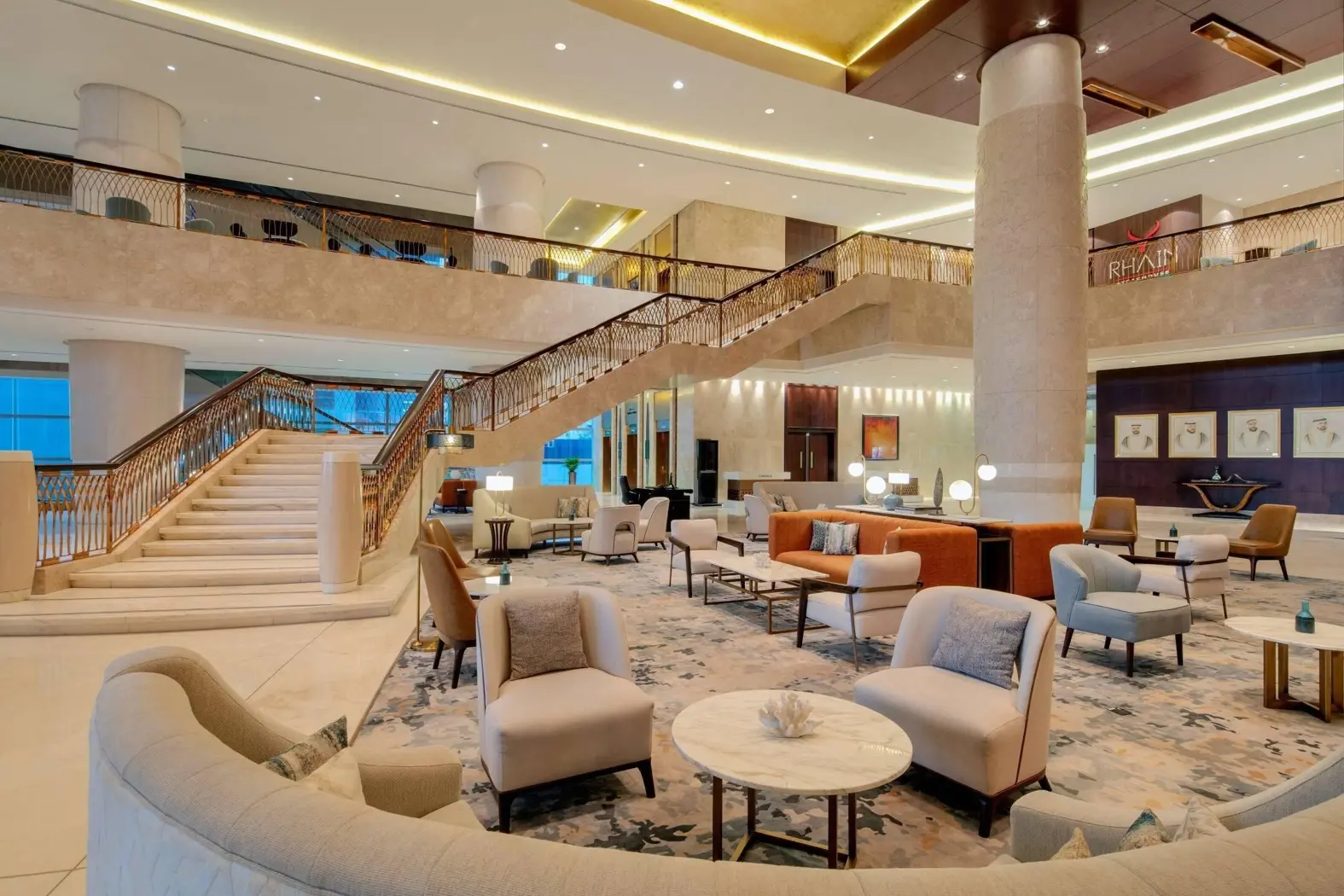
Existing projects illustrate the material’s architectural range. At Conrad Dubai, Rosa Portugal marble features in flooring and columns, while the lobby staircase is identified as Rosa Portogallo. Its soft colour and expressive veining bring visual continuity to an interior whose impact depends on both scale and detail.
At Grand Hyatt Dubai, Portuguese AmareloNegrais stone demonstrates another approach to hospitality interiors. In Abu Dhabi, Portuguese Gris Liso limestone at the entrance to Nation Towers’ shopping centre offers a quieter expression, with honed surfaces and restrained grey tones suited to substantial architectural compositions.
These references point to a palette extending well beyond a single signature finish. Portuguese marble offers luminosity and individual veining; limestone introduces tonal depth and understated texture; granite provides robust options for demanding applications; and slate brings a distinctive layered character. Each requires selection according to its properties, intended use and environmental exposure.
For premium residences, hotels and commercial interiors, that diversity creates opportunities to develop a coherent material language across floors, walls, staircases, bathrooms and bespoke features. Selected slabs, coordinated vein patterns and precisely judged finishes can turn natural variation into an integral part of the design.
The supplier’s contribution is decisive. Portuguese companies combine established stoneworking skills with advanced processing technologies, enabling bespoke dimensions, complex geometries and resolved details. Block selection, cutting tolerances, surface treatment and joint coordination all influence whether the completed work fulfils the architect’s intention.
Dialogue between designers and suppliers allows appearance, performance and maintenance requirements to be considered together. For Emirati projects, this means assessing the chosen stone and finish against the demands of interior use, exterior exposure, moisture and pedestrian traffic.
Through “Portuguese Stone – The Natural Path”, ANIET is positioning this combination of material individuality and professional competence before the Emirates’ design community. The opportunity is to specify more than a beautiful surface: a natural material shaped by specialist knowledge, capable of giving spaces a distinctive and enduring architectural identity.